


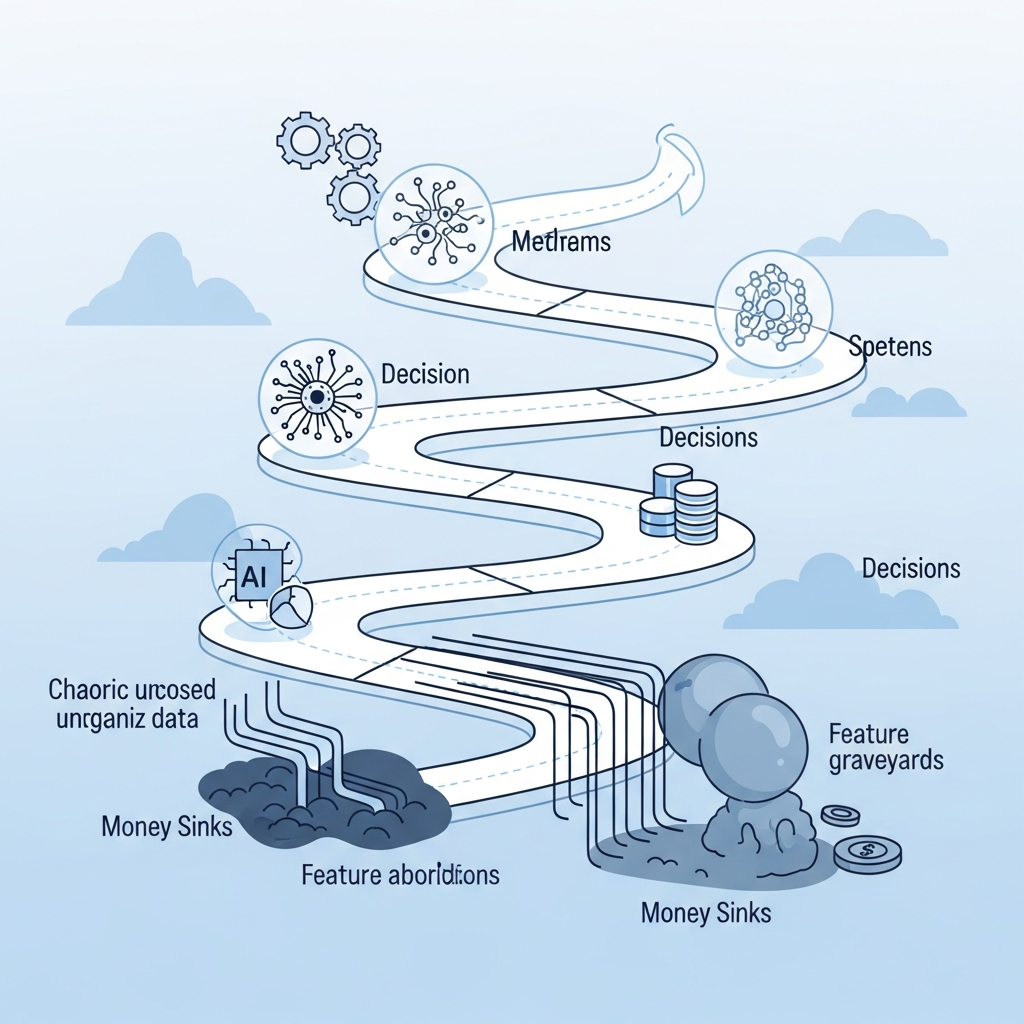
The Promise and Peril of AI in SaaS
Artificial Intelligence (AI) has moved from a futuristic concept to a present-day imperative for SaaS companies. From enhancing user experience with personalized recommendations to automating complex workflows and deriving deeper insights from data, the potential for AI to revolutionize SaaS offerings is immense. This promise has naturally led to a rush among businesses to integrate AI features into their products, often envisioning ambitious AI roadmaps for 2026 and beyond.
However, the journey to AI integration is fraught with challenges. While the enthusiasm is understandable, many initiatives stumble not because of a lack of innovation, but due to fundamental missteps in planning and execution. The common belief is that more AI features automatically lead to better products or higher ROI. But what if the very act of prioritizing AI features leads to a ‘feature graveyard’ where innovations fail to deliver measurable impact?
This post delves into the critical mistakes that often derail AI initiatives in SaaS and outlines how to build a resilient, effective AI roadmap that delivers real value without breaking the bank or your long-term strategy.
Unpacking the Common Mistakes in AI Prioritization
Many promising AI ventures in the SaaS space falter because of a few recurring, yet avoidable, errors. Understanding these pitfalls is the first step toward building a successful AI strategy.
Mistake 1: Building Features Without Measurable Outcomes
One of the most significant reasons AI initiatives fail is the pursuit of features for the sake of having AI. Companies often invest heavily in complex algorithms or flashy functionalities without clearly defining what business problem they aim to solve or what tangible value these features will bring. The result? A ‘feature graveyard’ where resources are wasted on developments that don’t move the needle.
- Lack of ROI: Without measurable outcomes, it’s impossible to quantify the return on investment (ROI) for AI features.
- Disconnection from Business Goals: AI projects become isolated tech experiments rather than integral parts of a product or business strategy.
- Unused Features: Users might not adopt features that don’t directly address their pain points, leading to wasted development effort.
Mistake 2: Neglecting Data Quality and Accessibility
AI models are only as good as the data they’re trained on. The adage ‘garbage in, garbage out’ holds particularly true for AI. Many SaaS companies jump into AI development without adequately preparing their data infrastructure or ensuring the quality, accuracy, and accessibility of their data.
- Poor Model Performance: Inaccurate, incomplete, or biased data leads to unreliable and underperforming AI models.
- Data Silos: Data scattered across different systems without proper integration hinders the ability to train comprehensive models.
- Bias and Fairness Issues: Biased training data can lead to AI systems that perpetuate or even amplify societal biases, leading to ethical and reputational risks.
Mistake 3: Skipping Robust Governance and Ethical Considerations
As AI becomes more sophisticated, so do the ethical, legal, and operational questions surrounding its use. Neglecting a robust governance framework can expose SaaS companies to significant risks, including regulatory fines, reputational damage, and loss of customer trust.
- Lack of Transparency: The ‘black box’ nature of some AI models can make it difficult to understand how decisions are made, impacting user trust.
- Data Privacy Concerns: Handling sensitive customer data for AI training requires strict adherence to regulations like GDPR or CCPA.
- Unintended Consequences: Without oversight, AI features can lead to unforeseen negative impacts on users or business operations.
Mistake 4: Underestimating the True Cost of AI
The total cost of ownership (TCO) for AI extends far beyond initial development. Many companies fail to account for the ongoing expenses associated with AI initiatives, leading to budget overruns and unsustainable projects.
- Infrastructure Costs: High-performance computing, specialized hardware (GPUs), and cloud services can be expensive.
- Maintenance and Monitoring: AI models require continuous monitoring, retraining, and updates to remain effective.
- Talent Acquisition: The demand for skilled AI engineers, data scientists, and MLOps specialists is high, driving up personnel costs.
- Data Storage and Management: Storing and managing large datasets for AI also incurs significant costs.
Crafting a Resilient AI Roadmap: Best Practices for SaaS
Avoiding these common pitfalls requires a strategic, intentional approach to AI integration. Here’s how SaaS companies can build a more resilient and impactful AI roadmap for 2026 and beyond.
Define Clear, Measurable Business Outcomes
Before writing a single line of code, clearly articulate what business problem each AI feature aims to solve and how its success will be measured. Link AI initiatives directly to key performance indicators (KPIs) that align with your overall product and business strategy.
- Start with ‘Why’: Why do we need this AI feature? What specific user pain point or business inefficiency will it address?
- Set SMART Goals: Ensure goals are Specific, Measurable, Achievable, Relevant, and Time-bound.
- Pilot and Validate: Begin with smaller, well-defined projects to validate assumptions and gather feedback before scaling.
Invest in Data Strategy and Quality
Data is the lifeblood of AI. Prioritize building a robust data strategy that focuses on data quality, governance, and accessibility from the outset.
- Data Cleansing and Preprocessing: Invest in tools and processes to clean, normalize, and prepare data for AI models.
- Centralized Data Infrastructure: Implement solutions that break down data silos and make data readily accessible for AI development.
- Data Governance Frameworks: Establish clear policies for data collection, storage, usage, and privacy compliance.
Implement Comprehensive AI Governance from Day One
Proactive AI governance is crucial for mitigating risks and building trust. This involves setting up frameworks for ethical AI development, compliance, and responsible deployment.
- Cross-functional Teams: Involve legal, ethics, product, and engineering teams in AI governance discussions.
- Explainability and Transparency: Strive for AI models that are as interpretable as possible, especially in critical applications.
- Regular Audits: Periodically review AI systems for bias, accuracy, and adherence to ethical guidelines.
Conduct Thorough Cost-Benefit Analysis
Adopt a holistic view of AI costs, including development, infrastructure, maintenance, and talent. This allows for more accurate budgeting and ensures that the expected benefits justify the investment.
- Total Cost of Ownership (TCO): Factor in all lifecycle costs of an AI feature, not just initial development.
- Phased Rollout: Consider a phased approach to AI deployment, allowing for validation of ROI at each stage.
- Resource Optimization: Explore options for cost-effective infrastructure and model optimization techniques.
The Future of SaaS is Intelligent, but Also Intentional
AI is undeniably transformative for the SaaS industry. However, true success in integrating AI into your product roadmap hinges on moving beyond the hype and adopting a disciplined, strategic approach. By focusing on measurable outcomes, prioritizing data quality, implementing robust governance, and meticulously managing costs, SaaS companies can navigate the complexities of AI development and unlock its full potential, ensuring their innovations don’t just exist, but truly thrive.